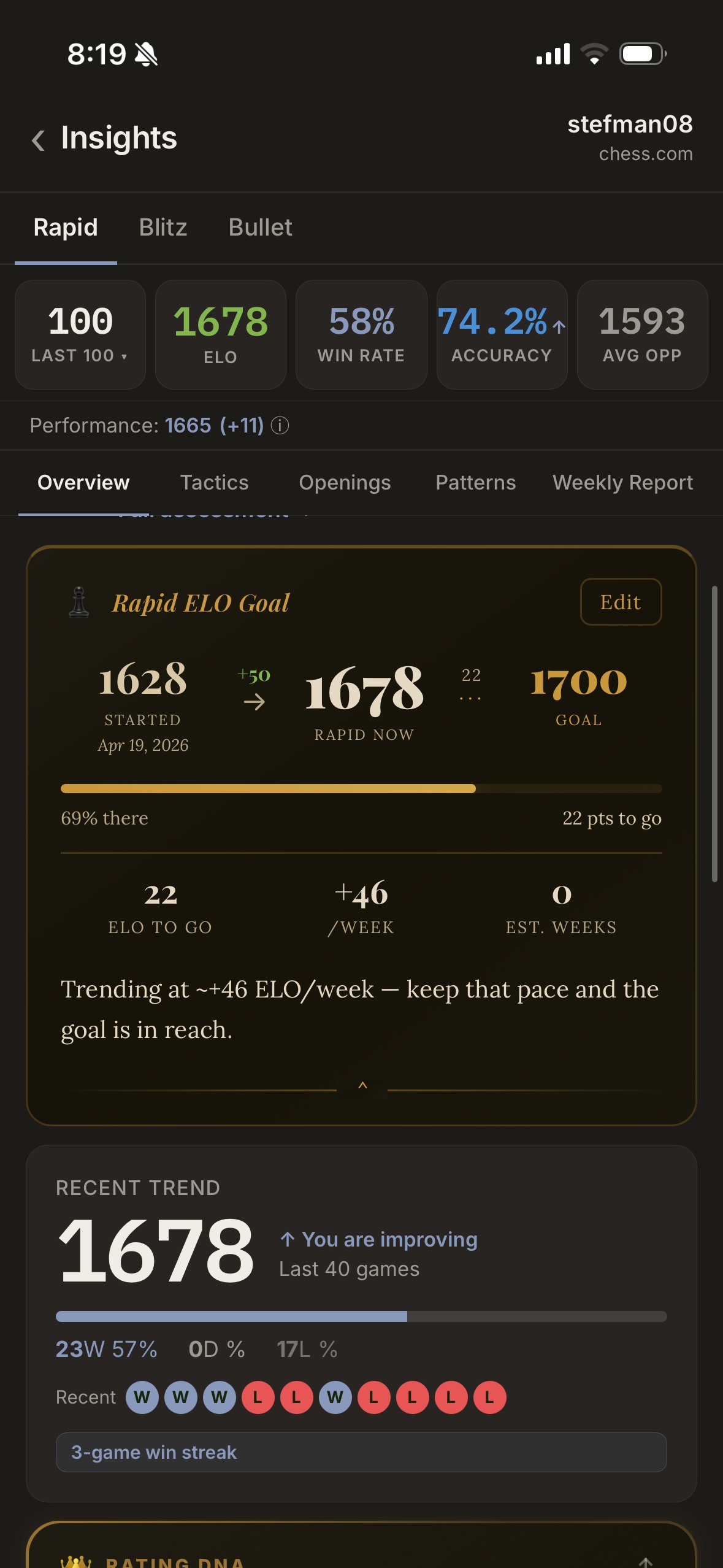
Six months at 1399. I'd play on Sunday mornings, Tuesday nights, sometimes both. Grind puzzles at lunch. Watch Levy explain the Caro-Kann for the third time. Every Monday I was still 1399, plus or minus twelve.
The rating graph looked like a heartbeat monitor for someone who wasn't dying but also wasn't especially alive.
What finally worked wasn't a secret. It wasn't a coach. I'm not exceptionally smart at chess and I don't have time to play four hours a day. All I did was stop doing what wasn't working. Ninety days later I was 1698.
The timeline below is real. The numbers are real. A few are embarrassing.
What wasn't working (and why)
I was doing all the things Chess Improvement Twitter tells you to do.
Twenty games a weekend. Puzzle rush most mornings. An opening video at lunch, "notes" in a Google Doc I stopped opening after week three. Agadmator's latest at dinner.
Didn't work. Not even a little.
The reason took me longer to see than it should have. I was accumulating reps without learning from any of them. You can play a thousand rapid games purely on calendar exposure and get marginally better, sure. But the same mistakes walk into every single one of them because you never look at the games again.
The puzzles were the most frustrating part. I'd solve a back-rank puzzle cleanly in the morning, then hang a piece in the exact same motif five hours later in a real game. The puzzle showed me the pattern in a clean, decontextualized position. In my actual middlegame, with a clock running and a live opponent and three other things on the board, I couldn't connect it. My brain wasn't learning from the puzzle. It was just doing the puzzle.
The one shift: analyzing my own games
At day 30 I did something I'd been avoiding for six months. I stopped playing for a week. Instead I'd analyze my last twenty rapid losses.
One rule, which turned out to be the whole thing: no engine until I'd written down what I was actually thinking.
Here's what that looked like in practice. I'd open a game, click through move by move, and at every moment where I'd paused (or where I'd blundered), I'd write, literally in a notebook with a pen, four things.
What did I see? What candidates did I consider? Why did I pick the move I picked? What do I think I missed?
Then, and only then, I'd turn the engine on.
The pattern was humiliating. I was blundering in positions I'd spent less than ten seconds on. Not sophisticated tactical errors. Didn't-calculate-at-all errors, because I'd pre-decided the next move would be easy. The clock was fine. I just wasn't thinking.
I remember one position exactly. White queen on d4, my knight on f6, and I played Nxe4 on autopilot because I'd been planning it two moves ago. Queen takes knight. The engine labeled it "Blunder??" with two question marks, which felt personal.
That shift alone added around forty ELO in the first two weeks after I started. I wasn't training anything new. I was just catching myself drifting.
Narrowing my openings (weeks 4-8)
I played six opening systems as White. I played them all equally badly.
I'd start a London, fumble into some quasi-d4 position I didn't know, blink at the board for ninety seconds, and play something reasonable-looking. By move fifteen I was defending an equal middlegame with twelve minutes to my opponent's nineteen. Then I'd lose the middlegame because I was tired.
So I cut to one opening for each color. London as White. Caro-Kann as Black.
Three weeks to learn the key positions, not the moves. That distinction matters more than it sounds. Memorizing a twenty-move line gives you nothing when your opponent plays move six off-book. Understanding that the London wants a specific pawn structure and piece placement gives you a compass for whatever move they play.
The payoff wasn't flashy. I wasn't surprising anyone with prep. I was arriving in familiar positions with more time on my clock, which is the actual point of opening prep at my level.
Targeted tactics, not random puzzles
From my game analysis I'd started tagging mistakes in the notebook. "Knight fork missed." "Back-rank not defended." "Overloaded defender." "Initiative surrendered." After thirty games of this, three patterns were responsible for more than half my losses.
So I drilled those. Ten or fifteen position reps a day, specific to my blind spots. Not fifty random ones.
This was a lot more efficient. Two weeks in, the "knight fork missed" tag almost vanished from my loss log. Not because I'd solved it forever, I'm sure it comes back when I'm tired, but because I'd finally internalized the visual pattern in positions that actually looked like my games.
Chess.com's daily puzzle is a great thing. I'm not knocking it. But it's trained on what chess.com thinks the broader pool needs, not what you specifically need.
Endgames (weeks 6-12)
My middlegame was 1600. My endgame was 1300.
I was drawing won positions. Losing endings I should have won. Fifteen minutes a day on basic endgames. King and pawn, then rook endings, then opposition and zugzwang. Silman's Complete Endgame Course for the curriculum. I worked through the sections, and more importantly I played them out against the engine to practice the technique rather than just read the prose.
My win rate in close endgames went from around forty percent to seventy over six weeks. That's where a lot of the final eighty ELO came from. Not from winning more positions, but from not throwing the ones I'd already won.
When I played mattered more than how much
Around week eight I started tracking my rapid results by hour of day. A spreadsheet. Date, time, result, opponent rating. After two hundred games the map was pretty clear.
Win rate 10pm to midnight: 38%.
Win rate 11am to noon: 64%.
Same player. Same rating pool. Just tired brain versus fresh brain.
So I stopped playing rated games after 10pm. Simple as that. If I wanted to play in the evening, I played unrated or played bots.
Side note, I also quit coffee during this stretch. Probably unrelated. Probably.
The numbers
The real progression wasn't clean. Rating charts never are.
- Day 1: 1399
- Day 30: 1437 (analysis sprint, first gains)
- Day 45: 1491 (momentum)
- Day 60: 1462 (lost four in a row midweek, still bruised)
- Day 75: 1584 (endgame training kicking in, won a bunch of equal endings)
- Day 90: 1698
Net: 299 ELO. A lot of it came in bursts, with at least one week where the graph went sideways and one where it went down hard. The 1462 at day 60 was after a late-night tournament I had no business playing. Lost rating, felt stupid, made the "don't play after 10pm" rule I already mentioned.
What I'd tell someone starting over
Stop treating chess like a reflex. Treat it like a skill with a real method. Every game should produce a lesson, and if it doesn't, you didn't look hard enough.
Look at your own games with the engine off first. Write down what you were thinking. Then check Stockfish.
Pick one opening per color. Don't learn five of them at 40% each.
Drill the tactics you actually miss. Ignore the daily puzzle pool if your own mistakes tell you something different.
Know your peak hours and don't donate rating to tired-you.
That's most of it. None of it is novel, and none of it is hard to understand. Doing it every day for three months is the part nobody talks about.
A quick note on tools
I did this manually for the first sixty days. Spreadsheet for game logs. Notebook for critical-moment notes. Second column for tags. A file on my desk I labeled "games" in black marker, because my handwriting is bad and I needed it not to confuse me. It worked fine. Slow, but fine.
In the last thirty days I switched to Chessy, which does the analysis and pattern-tagging automatically and generates puzzles from the positions I'd actually missed. I was skeptical for a week. The puzzle calibration felt off at first and I almost canceled. By the second week it was drilling me on exactly the patterns I'd been hand-tagging. Cut my review time by maybe 80%.
That last eighty ELO came faster because of it. I want to be honest though: the method matters more than the tool. If you'll keep a notebook, you don't need an app. The habit is the work.
Closing thought
299 ELO isn't a miracle. It's what happens when you stop grinding and start learning. When the game you just finished produces a written note your next game can actually use.
Anyone stuck on a plateau can do this. The method is stupidly simple. The hard part is doing it every day for three months when progress feels slow enough that you can't feel the needle move.
Do it anyway. You'll feel it in thirty days.